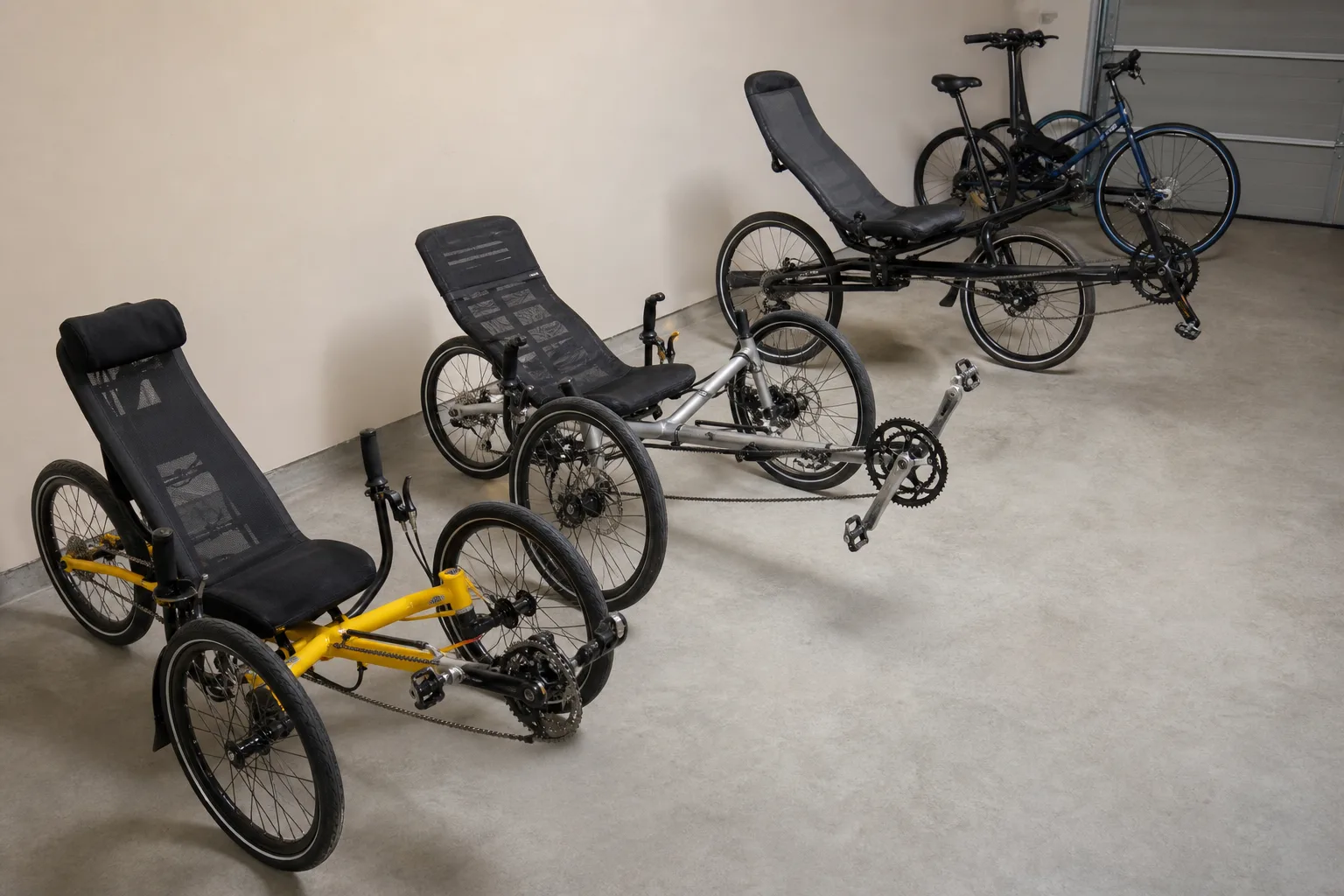
The hill that settled the question was two blocks long, on the way back from a demo ride, and it had never once registered as a hill on an upright bike. On the borrowed tadpole trike it stopped being scenery and became a problem. Around halfway up the cadence fell, the legs loaded, and the usual response, rising off the saddle to throw body weight into the pedals, was simply not available. There is nothing to rise off. The seat holds the torso, the back is braced, and the only power source is what the legs can produce while seated.
That is not a defect, and it is not a reason to walk away from recumbents. It is a design consequence with a straightforward answer, which is gearing chosen for the route rather than gearing chosen from a catalog. But it does mean the careful reader checks a different set of numbers before buying, and checks them in a particular order: fit first, because fit determines whether the legs can work at all, then bottom gear, because bottom gear determines whether the legs are enough.
X-seam, and why the tape measure comes before the test ride
Recumbent fit starts with x-seam, the distance from the base of the back to the bottom of the heel with the leg extended, measured sitting on the floor against a wall with a board pressed flat to the feet. That single figure decides which frames are candidates. Manufacturers publish an x-seam range for each model, and a machine whose range brackets your measurement can be adjusted to you; one that does not cannot be rescued by a longer boom or a shifted seat. Take the measurement twice, in cycling shoes, and write it down before contacting anyone.
The boom is what converts that number into a riding position. On most recumbents the bottom bracket sits at the end of a telescoping tube clamped into the front of the frame, and sliding it in or out sets leg extension exactly as saddle height does on an upright. Set it long and the knees lock, the hips rock, and the feet go numb; set it short and the knees rise into the steering. Correct extension leaves a slight bend at full stroke with the heel supported, and it wants checking again after a week, because the seat position you accept in a parking lot is not the one you want at mile twenty.
Seat angle and bottom bracket height, the two settings people leave alone
Seat angle, meaning how far back the seat reclines, trades comfort and visibility against aerodynamics and, importantly, against how much force the back can brace. A more upright seat, somewhere near the middle of a typical adjustment range, gives better sight lines in traffic and a stronger feeling of pushing against something solid. Bottom bracket height, the pedals relative to the seat, is fixed by the frame and matters more than most buyers realize. High pedals are fast and are also the leading cause of numb feet, because the feet sit above the heart and circulation suffers on long rides.
Numbness responds to specific fixes: a stiffer sole, a shoe half a size up, cleats moved rearward so the pressure spreads across the arch rather than concentrating on the ball, and boom length shortened by a few millimeters. Seat mesh tension is the parallel adjustment on the other end. Mesh that has stretched lets the hips sink, which quietly changes leg extension and creates hot spots at the shoulder blades, so the laces want re-tensioning every few months, evenly, top to bottom.
Choosing a bottom gear from the hills you actually ride
Do this empirically. Ride the steepest sustained climb on your regular route on an upright bike, note the gear you finish in and the cadence you hold, and then specify a recumbent bottom gear meaningfully lower than that, because seated-only power on a recumbent is lower than seated-plus-standing power upright. In practice that means a small chainring, a wide-range cassette, and a willingness to spin. Bicycle equipment sold in the United States falls under the oversight of the Consumer Product Safety Commission, but no regulator picks your gearing; the route does, and a shop that asks about your route before quoting a build is telling you something useful.
The second block of that hill went by easily on a later ride, on a machine with a properly set boom and a bottom gear roughly a third lower. Same legs, same grade, different arithmetic.